

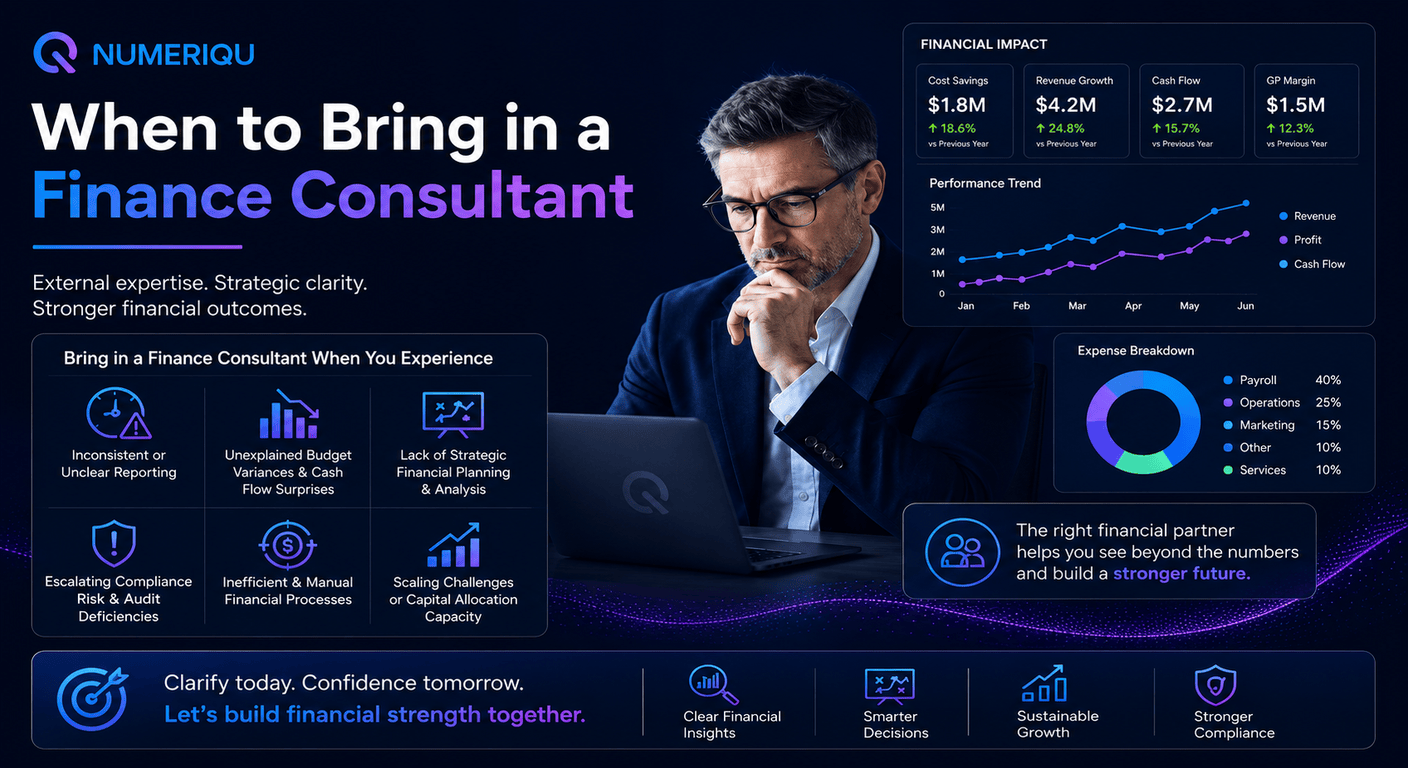

Slow reporting and unexpected budget shortfalls often signal a deeper financial challenge. Many businesses struggle with scaling their internal finance functions, leading to inaccurate forecasts and missed strategic opportunities. This article will explore critical indicators suggesting that external business consultant services can provide significant value. A finance consultant provides specialized financial expertise to optimize operations, enhance decision-making, and navigate complex fiscal landscapes.
Signs Your Business Needs Outside Financial Expertise
Even robust internal finance departments can encounter limitations as an enterprise scales or faces new market complexities. Identifying these limitations early is crucial for maintaining operational integrity and strategic agility. Bringing in a skilled business consultant can provide a fresh perspective and specialized knowledge to address specific challenges without the overhead of a permanent hire. Combined with modern financial visibility platforms such as NumeriQu, businesses can gain deeper insights into operational performance while improving financial decision-making.
1. Persistent Inaccuracies in Financial Reporting
If monthly financial reports are consistently delayed, contain errors, or simply don’t align with operational realities, it’s a significant red flag. This indicates a breakdown in data collection, processing, or reconciliation. Without reliable data, leadership cannot make informed decisions about resource allocation, investment, or risk management.
An external finance consultant can audit existing processes, identify bottlenecks, and implement robust reporting frameworks, ensuring data accuracy and timeliness. Organizations can further enhance reporting visibility through solutions like NumeriQu, which provide centralized dashboards, automated reporting capabilities, and real-time access to critical financial information.
2. Budgeting and Forecasting Disconnects
Are your budgets consistently missed by wide margins? Do your financial forecasts fail to predict significant shifts in revenue or expenditure? This suggests a lack of sophisticated modeling or an incomplete understanding of market dynamics.
A business consultant specializing in financial planning can introduce advanced forecasting techniques, integrate operational data, and build more resilient budget models that align financial targets with strategic objectives. Platforms such as NumeriQu support this process by delivering integrated financial analytics, forecasting insights, and performance tracking that help leadership teams make proactive decisions rather than reactive adjustments.
3. Chronic Cash Flow Visibility Issues
For many businesses, managing cash flow is a constant challenge. If you frequently find yourself surprised by liquidity shortages or struggle to project future cash positions accurately, your internal finance function might be overwhelmed.
External consultancy services can implement cash flow optimization strategies, introduce sophisticated treasury management tools, and establish clear policies for working capital management, enhancing financial stability. With NumeriQu’s real-time financial reporting and visibility tools, organizations can gain greater transparency into cash flow trends, helping reduce uncertainty and improve liquidity planning.
4. Lack of Strategic Financial Planning
Beyond day-to-day operations, finance should be a strategic partner, guiding long-term growth and investment decisions. If your finance team is primarily transactional and lacks the capacity for strategic business advisory, opportunities for market expansion, mergers and acquisitions, or capital restructuring may be overlooked.
Engaging a finance consultant brings strategic acumen to the table, helping develop financial roadmaps that support overall business goals and market positioning. When paired with NumeriQu’s executive dashboards and business intelligence capabilities, leadership teams can access deeper financial insights that support strategic planning and long-term growth initiatives.
5. Compliance and Audit Readiness Challenges
Navigating an increasingly complex regulatory landscape, from tax codes to industry-specific financial standards, requires specialized knowledge. If your business consistently struggles with audit preparations or faces compliance risks, it exposes the organization to significant penalties and reputational damage. A business consultant can conduct compliance audits, establish internal controls, and ensure your systems are continuously audit-ready, mitigating legal and financial exposure. For instance, adherence to frameworks like FASB accounting standards is critical for public and many private companies.
6. Inefficient Financial Processes and Technology Gaps
Are your finance operations still heavily reliant on manual data entry, disconnected spreadsheets, or outdated software? Inefficient processes lead to wasted time, increased errors, and difficulty scaling.
A finance consultant can assess your existing technology stack, recommend and implement modern financial management systems, and optimize workflows for greater efficiency and automation. This often involves integrating disparate systems for a unified financial view. NumeriQu’s integrated financial intelligence platform helps organizations consolidate data, automate reporting processes, and provide stakeholders with a single source of financial truth.
7. Significant Operational Scaling Challenges
Rapid growth, whether organic or through acquisition, places immense strain on existing finance structures. If your team cannot keep pace with increasing transaction volumes, new reporting requirements, or the integration of acquired entities, it’s a clear sign of growing pains.
Business consultants specialize in scaling financial operations, designing adaptable frameworks that support expansion while maintaining control and visibility. By leveraging solutions such as NumeriQu, organizations can improve reporting scalability, gain deeper operational visibility, and support sustainable growth without sacrificing financial control.
How NumeriQu Enables This Capability
NumeriQu provides a robust platform designed to integrate deeply into enterprise financial workflows, moving beyond conventional business intelligence tools and generic ERP reporting. It offers a structured approach to critical financial functions, delivering granular control and comprehensive insights. For example, its variance analysis capabilities allow finance teams to meticulously compare actual performance against budgets and forecasts, identifying root causes for deviations at the transaction level rather than just a high-level summary. The system achieves financial reporting automation by directly linking general ledgers and operational data sources, ensuring that consolidated statements, income statements, and balance sheets are generated consistently and accurately on demand, reducing manual intervention from days to minutes.
Reconciliation is automated across multiple data streams and entities, flagging discrepancies in real-time. For multi-entity consolidation, NumeriQu aggregates financial data from diverse subsidiaries, even those with varying charts of accounts or currencies, into a single, unified view, critical for global enterprises. This capability significantly streamlines the closing process and provides a consolidated financial picture without manual aggregation errors. Furthermore, its built-in audit trails and configurable access controls enhance audit readiness by providing transparent data lineage and ensuring compliance with regulatory requirements, significantly reducing the burden during external audits. This differs from standard BI tools, which often present data without the deep transactional logic or reconciliation capabilities needed for financial integrity, and from ERP reporting, which can be rigid and lack the flexibility for custom, real-time analysis required by dynamic enterprise finance functions.
| Capability | Traditional Approach (Internal) | AI-Enhanced System (External Consultant-Led) |
| Data Aggregation | Manual data entry, fragmented spreadsheets, siloed departmental systems. | Automated ingestion from all sources (ERP, CRM, operational), real-time aggregation, unified data lake. |
| Data Lineage Tracking | Difficult, incomplete trails; reliance on individual knowledge. | End-to-end audit trails, automated tagging, transparent source-to-report visibility. |
| Multi-Entity Consolidation | Labor-intensive, prone to errors, delayed reporting cycles. | Automated, real-time consolidation with intercompany eliminations and currency conversions. |
| Audit Readiness | Reactive data pulls, significant manual effort to prepare documentation. | Continuous compliance monitoring, automated evidence gathering, instant access to audit-ready reports. |
| Scenario Modelling | Static spreadsheets, limited variables, slow to update. | Dynamic, AI-powered “what-if” analysis, real-time impact assessments across multiple variables. |
This table illustrates a fundamental shift. Traditional internal finance functions often operate reactively, managing data and reporting through manual, disjointed processes. The introduction of an external finance consultant, leveraging an AI-enhanced system, fundamentally transforms these capabilities. It transitions the enterprise from a data management struggle to a strategic decision-making powerhouse, providing predictive insights and automated compliance that internal teams alone might take years to build or lack the specialized expertise to implement.
Scenario 1: Optimizing Growth in a Rapidly Scaling Mid-Market Enterprise
Problem: A mid-market technology company experiencing 30% year-over-year growth found its internal finance team struggling to keep up. Financial closes were extending to 15 days, variance analysis was superficial, and cash flow projections were frequently inaccurate, hindering strategic investment decisions. The CFO recognized the need for external business advisory to professionalize their financial operations.
Implementation: The company engaged a finance consultant who implemented an integrated financial planning and analysis (FP&A) solution. This involved migrating from disparate spreadsheets to a centralized platform, automating data feeds from their ERP and CRM systems, and standardizing reporting templates. The consultant also provided training to the internal team on advanced forecasting methodologies and KPI tracking.
Measurable Outcome: Within six months, monthly financial closes were reduced to seven days. Cash flow forecast accuracy improved by 20%, leading to better working capital management. The internal team gained greater confidence in their numbers, allowing leadership to make more timely and informed decisions regarding product development and market expansion.
Scenario 2: Enhancing Audit Readiness for a Multi-National Conglomerate
Problem: A large manufacturing conglomerate with operations across five countries faced increasing pressure to streamline its annual audit process. Reconciling intercompany transactions, consolidating financial statements from different currencies, and ensuring consistent compliance across diverse regulatory environments was a monumental, time-consuming task for their internal finance department.
Implementation: The enterprise hired business consultants specializing in financial transformation. These consultants implemented a global financial consolidation and reporting platform. This included configuring automated intercompany eliminations, standardizing chart of accounts mappings, and establishing automated controls for data validation. They also developed a comprehensive data governance framework and facilitated the integration of compliance tools.
Measurable Outcome: The time required for annual audit preparation was reduced by 40%, significantly cutting external audit fees. The quality of financial data improved, leading to zero significant audit findings related to data integrity. The enhanced audit readiness not only mitigated compliance risk but also freed up internal finance staff to focus on more strategic analysis rather than reactive data compilation.
Before vs. After: The Impact of Strategic Financial Consulting
- Reporting Speed: Before, financial reports could take weeks to compile, often delivered reactively. After, automated systems provide real-time dashboards and reports within days or even hours, enabling proactive decision-making.
- Error Reduction: Manual processes and fragmented data led to high error rates and frequent restatements. Post-consulting, integrated systems with automated reconciliation drastically reduce human error, improving data integrity.
- Decision Quality: Decisions were based on outdated or incomplete information, leading to missed opportunities or costly mistakes. With accurate, timely insights from enhanced financial systems, leadership makes strategic choices backed by robust data.
Advanced Financial Dashboard Layout and Analytics
Modern finance dashboards, often implemented with the guidance of a finance consultant, are designed for clarity and actionability. They typically feature customizable widgets displaying key financial performance indicators (KPIs) such as gross profit margin, operating expenses, cash conversion cycle, and EBITDA. Drill-down capabilities allow users to move from high-level summaries to transactional details. Role-based views ensure that CFOs see strategic insights, controllers monitor operational efficiency, and line managers track departmental budgets. These dashboards go beyond simple reporting, incorporating predictive analytics to highlight trends and potential future issues, offering prescriptive recommendations to optimize outcomes. This level of sophistication is a hallmark of advanced consultancy services focused on tangible operational improvements.
Technology Maturity and Enterprise Adoption Timeline
The journey towards an optimized financial function typically progresses through several stages of technology maturity. Initially, many enterprises rely on foundational ERP systems for transactional processing and basic reporting. The next stage involves integrating specialized tools for budgeting, forecasting, and advanced analytics. This is where business consultants often play a crucial role, guiding the selection and implementation of best-of-breed solutions that complement existing infrastructure. For further insights into the evolving financial landscape, consider Deloitte’s insights on the Future of Finance.
Full enterprise adoption involves not just the technology deployment but also comprehensive change management, extensive user training, and the establishment of new processes and governance frameworks. A typical timeline for a significant financial transformation, from initial assessment to full operationalization, can range from 9 to 18 months, depending on the complexity of the organization and the scope of the systems being implemented. Early adoption focuses on automating core processes, while later phases integrate AI for predictive capabilities and continuous improvement, ensuring the enterprise remains at the forefront of financial management practices. Organizations that effectively leverage business advisory throughout this timeline achieve faster ROI and more sustainable operational shifts.
Key Takeaways for Engaging a Finance Consultant
- Identify clear pain points: From slow reporting to budget surprises, pinpointing specific challenges clarifies the scope for external help.
- Recognize growth limits: Internal finance teams can be overwhelmed by rapid scaling; a finance consultant provides scalable solutions.
- Seek strategic alignment: Leverage external business advisory for long-term planning and M&A support.
- Prioritize compliance and risk: Ensure robust controls and audit readiness with specialized consultancy services.
- Embrace technological advancement: Modernize outdated processes with expert guidance on integrated financial systems.
Frequently Asked Questions About Financial Consulting
What are the primary indicators that a business needs a finance consultant?
Key indicators include consistent inaccuracies in financial reports, significant discrepancies in budgeting and forecasting, persistent cash flow visibility issues, a noticeable lack of strategic financial planning, and ongoing challenges with compliance and audit readiness. These signs suggest that internal capabilities might be stretched or lacking specialized expertise, where business consultant services can fill the gap.
How do business consultant services differ from hiring a full-time CFO?
While both provide financial leadership, business consultant services offer external, project-based expertise, focusing on specific challenges or strategic initiatives without the overhead of a permanent executive role. A full-time CFO assumes ongoing leadership, manages an internal team, and is deeply embedded in daily operations. A consultant often brings a broader perspective from various industries and can accelerate specific improvements.
Can a financial advisor help with long-term strategic planning?
Absolutely. Many financial advisor professionals specialize in business advisory for long-term strategic planning. They assist with capital structure optimization, mergers and acquisitions strategies, market entry analysis, and financial modeling for sustained growth. Their external perspective can be invaluable in crafting a robust financial roadmap that aligns with the organization’s overarching vision.
What immediate benefits can consultancy services provide to a small business?
For a small business, immediate benefits of consultancy services often include improved cash flow management, clearer and more accurate budgeting, streamlined financial processes, and enhanced understanding of profitability drivers. These changes can lead to better decision-making, reduced operational costs, and a stronger foundation for future growth.
How does engaging business consultants impact audit readiness?
Engaging business consultants significantly enhances audit readiness by implementing stronger internal controls, ensuring data integrity across financial systems, and establishing comprehensive documentation practices. They help configure systems to produce audit-ready reports, streamline data requests from auditors, and proactively identify and mitigate potential compliance issues, saving time and resources during the audit process.
If your organization is evaluating scalable operating models, When to Bring in a Finance Consultant: Signs Your Business Needs Outside Expertise may warrant a structured review across cost, governance, and long-term operational resilience.
To explore what that could look like in practice, contact NumeriQu for a consultative discussion.