

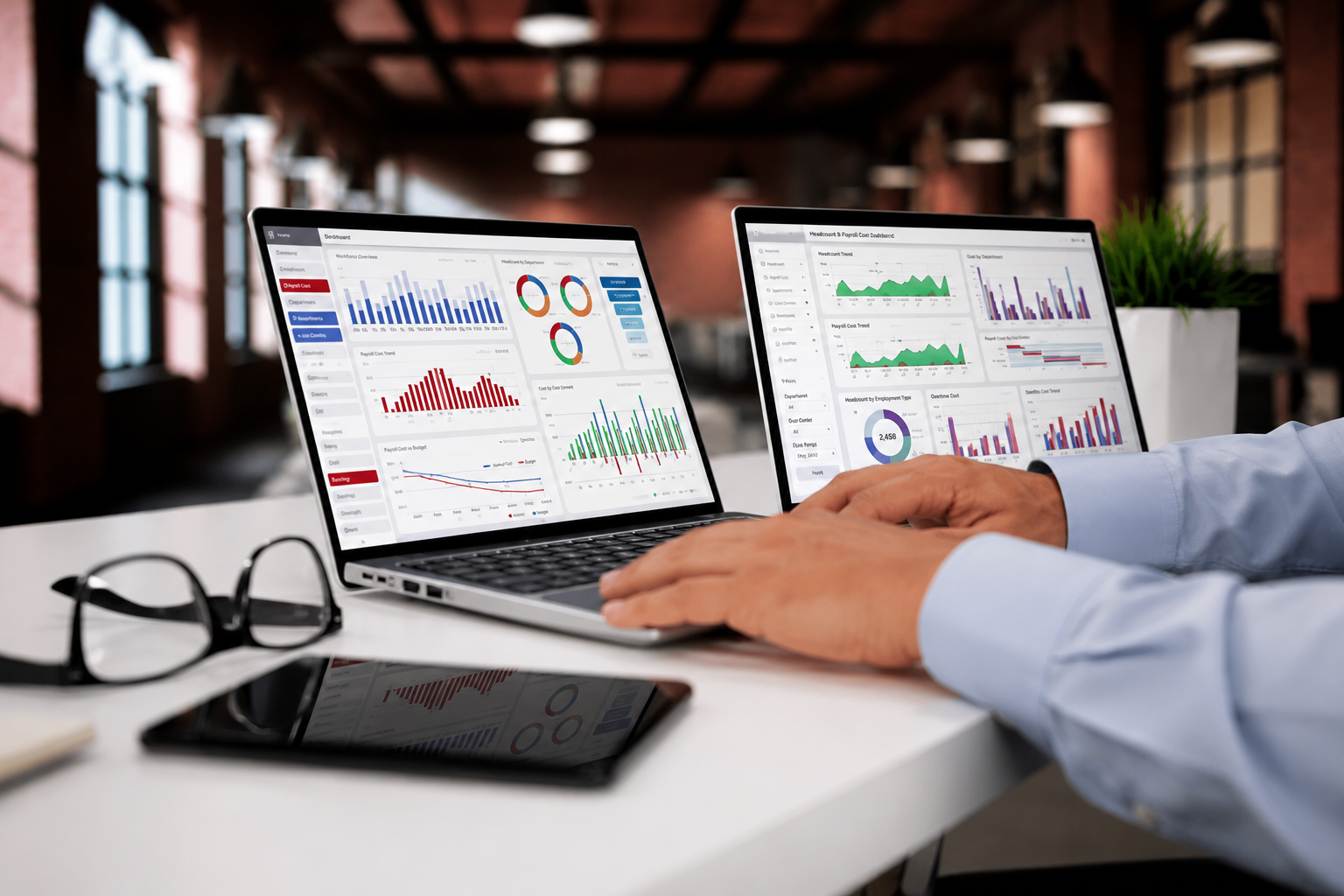

Achieving unified headcount and payroll cost visibility is a persistent operational challenge for many enterprises, leading to suboptimal workforce planning and budget overruns. The inherent silos between finance and human resources data systems frequently obscure a comprehensive understanding of an organization’s most significant expenditure: its people.
This article explores how a robust payroll cost dashboard provides integrated people cost insights, consolidating critical data points to empower both finance and HR leaders. We will delve into the architecture, deployment considerations, and the measurable impact of such a system on strategic workforce planning and cost control.
An integrated dashboard, in this context, refers to a single, analytical platform that harmonizes disparate headcount, salary, benefits, and contingent worker data, presenting a real-time, consolidated view of workforce expenses against budgets.
The Challenge of Fragmented People Cost Data
Historically, finance departments have relied on general ledger extracts and payroll system reports to track labor costs. Concurrently, HR maintains separate systems for headcount, compensation structures, benefits enrollment, and performance data. This division necessitates manual reconciliation efforts, often through cumbersome spreadsheets, which are prone to errors and provide only historical snapshots.
Such fragmentation inhibits proactive decision-making. Finance lacks granular, forward-looking data to model labor cost impacts accurately, while HR struggles to quantify the financial implications of talent strategies. The result is often reactive cost management and missed opportunities for strategic workforce optimization.
The Integrated Payroll Cost Dashboard: A Strategic Imperative
A modern, integrated payroll cost dashboard acts as a central nervous system for people-related financial data. Organizations adopting workforce planning and human capital analytics can better align finance and HR strategies for long-term workforce optimization It moves beyond simple expense reporting to provide contextual intelligence. This allows finance to track actual payroll costs versus budget by department, project, or even specific initiatives, with real-time accuracy.
For HR, it transforms data into actionable insights for talent acquisition, retention, and compensation strategy. The ability to correlate headcount changes with associated costs, analyze attrition impacts, or model the financial implications of proposed salary adjustments becomes instantaneous and data-driven.
Key Architectural Components
The foundation of an effective integrated dashboard system rests on several critical architectural layers:
- Data Ingestion Layer: Connectors to various source systems, including ERP (e.g., SAP, Oracle), HRIS (e.g., Workday, SuccessFactors), Time & Attendance, Benefits administration, and contingent workforce management platforms. This layer must support both batch and real-time data feeds.
- Data Harmonization Layer: A crucial component responsible for cleaning, transforming, and standardizing data from disparate sources. This involves resolving discrepancies in data definitions, currency conversion, and employee identifiers to create a unified data model.
- Data Lake/Warehouse: A scalable repository designed to store raw and processed data. This provides the historical depth necessary for trend analysis and predictive modeling.
- Analytical Processing Engine: This layer executes complex calculations, aggregations, and business logic to derive key performance indicators (KPIs) such as cost-per-employee, average salary by role, benefit utilization rates, and variance analysis.
- Reporting and Visualization Layer: The user-facing dashboard interface, providing interactive charts, tables, and drill-down capabilities. It must be configurable to meet the specific needs of finance, HR, and departmental leaders.
- Security and Governance Layer: Ensures data privacy, access control, auditability, and compliance with regulations like GDPR or CCPA.
How NumeriQu Enables This Capability
NumeriQu provides a sophisticated platform that serves as the central integration and analytics hub for comprehensive people cost visibility. Its architecture directly addresses the complexities of disparate enterprise systems by offering pre-built, resilient connectors to leading ERPs such as SAP S/4HANA, Oracle Cloud ERP, Microsoft Dynamics, and major HRIS platforms like Workday, SuccessFactors, and ADP. Beyond standard integrations, NumeriQu’s data ingestion capabilities extend to CRM and other operational systems where project-specific labor costs or contractor engagements might be tracked.
Once ingested, raw data undergoes a rigorous transformation process within NumeriQu’s platform. Leveraging advanced AI reconciliation algorithms, the system intelligently identifies and resolves inconsistencies in employee IDs, cost centers, and compensation components that typically plague manual aggregation. This AI-driven approach extends to anomaly detection, flagging unusual cost spikes or inconsistencies in headcount reporting that traditional rule-based systems might miss. The result is a unified data model, built on a single source of truth, specifically engineered for enterprise people cost analytics.
Unlike generic BI tools that require extensive custom development for financial and HR data integration, or ERP reporting modules limited to their own domain, NumeriQu delivers out-of-the-box dashboards tailored for finance and HR leaders. These dashboards offer real-time insights into headcount, salary, benefits, contractor expenses, and severance costs, enabling granular tracking of actual payroll cost versus budget by department, project, or even individual employee groups. Its differentiated value lies in the deep integration, AI-powered data integrity, and purpose-built analytics that go beyond mere aggregation, providing actionable intelligence for strategic workforce planning and robust cost control.
Key Deployment Challenges
Implementing an integrated dashboard, even with advanced tooling, presents several challenges:
- Data Quality and Governance: Inconsistent data definitions, missing data points, or incorrect classifications across source systems can undermine dashboard accuracy. Establishing robust data governance policies and cleansing routines is paramount.
- Integration Complexity: Connecting diverse legacy systems, some with proprietary APIs or limited connectivity options, requires significant technical expertise and careful planning.
- Change Management: Shifting from manual, siloed reporting to an integrated, automated system requires cultural adaptation within both finance and HR. Training and clear communication are essential for user adoption.
- Scalability and Performance: The system must be able to handle increasing data volumes and user concurrency without performance degradation, especially in large enterprises.
Traditional vs. Modern Payroll Cost Dashboards
| Capability | Traditional | AI System |
| Data Aggregation | Manual, spreadsheet-based, batch processing | Automated, real-time, multi-source integration |
| Data Lineage Tracking | Limited, difficult to audit | Full traceability, automated audit logs |
| Multi-Entity Consolidation | Complex, error-prone manual reconciliation | Automated, rule-based, rapid consolidation |
| Audit Readiness | Labor-intensive manual checks | Built-in controls, automated compliance checks |
| Scenario Modelling | Basic, static what-if analysis | Dynamic, predictive analytics, AI-driven simulations |
The contrast between traditional and AI-driven systems is stark, particularly in the realm of data integrity and foresight. An AI system not only automates the laborious aggregation process but also introduces predictive capabilities and enhanced audit readiness, transforming reactive reporting into proactive strategic decision support.
Optimizing Workforce Planning: Two Scenarios
Scenario 1: Proactive Budget Variance Management
- Problem: A global manufacturing firm consistently experienced significant payroll cost overruns in its R&D division, discovered only quarterly, making corrective action difficult and expensive. The finance team spent weeks manually cross-referencing HR data with ledger entries.
- Implementation: The firm implemented an integrated people cost dashboard that pulls real-time data from their Workday HRIS, SAP ERP, and a contractor management system. The dashboard provides daily updates on actual versus budgeted headcount and associated costs, segmented by project and cost center within R&D.
- Measurable Outcome: Finance and R&D leadership now receive automated alerts when cost variances exceed predefined thresholds. This enabled them to identify and address a potential 15% overrun in contractor expenses within two weeks, leading to a projected 30% reduction in quarterly budget variances for the R&D division.
Scenario 2: Strategic Workforce Restructuring Impact Analysis
- Problem: A rapidly expanding tech company needed to evaluate the financial implications of consolidating two operational departments, including potential redundancies and new hiring, but lacked a unified tool to model the combined people costs accurately.
- Implementation: The integrated dashboard’s scenario modeling feature was utilized. HR input projected headcount changes, severance packages, and new hire salary bands. Finance could immediately see the P&L impact, cash flow implications, and estimated ROI of the restructuring options in real-time.
- Measurable Outcome: By analyzing various restructuring scenarios, the company identified an optimal plan that minimized severance costs by 20% while accelerating the realization of efficiency gains. The ability to model these scenarios allowed for a 25% faster resolution in restructuring discussions and a more financially sound transition.
Before and After: Operational Impact
The transition to an integrated people cost system fundamentally alters operational workflows and strategic capabilities:
- Reporting Speed: From weeks of manual aggregation to instantaneous, real-time dashboards.
- Error Reduction: Significant decrease in data entry errors and reconciliation discrepancies due to automated data ingestion and AI-driven validation.
- Decision-Making Improvement: Shift from reactive, historical reporting to proactive, predictive analytics, enabling more informed and agile strategic choices across finance and HR.
Who Should Use This System
An integrated headcount and payroll cost dashboard is indispensable for a range of enterprise stakeholders:
- CFO and FP&A Teams: For robust budget management, accurate forecasting, and strategic financial planning related to workforce costs.
- CHRO and HR Leadership: For strategic workforce planning, compensation analysis, talent retention strategies, and quantifying HR initiatives’ financial impact.
- Departmental Heads: To manage their team’s operational budgets, monitor staffing levels, and understand the financial implications of their growth plans.
- Compliance and Audit Teams: For enhanced data lineage, audit readiness, and ensuring regulatory adherence in reporting people costs.
High-Performance Dashboard Layout
A well-designed dashboard is intuitive and action-oriented. Key elements include:
- Executive Summary View: High-level KPIs such as total payroll cost, headcount by type (full-time, contractor), cost per employee, and variance to budget.
- Trend Analysis: Visualizations showing payroll cost evolution over time, highlighting seasonal fluctuations or significant changes.
- Drill-Down Capabilities: Users can click on a high-level metric to explore underlying data, for instance, drilling from total payroll cost to departmental expenses, then to specific job roles.
- Geographic/Divisional Segmentation: Filters and views to analyze costs across different regions, business units, or legal entities.
- Scenario Simulators: Interactive tools for modeling the impact of potential compensation changes, hiring freezes, or expansion plans.
- Alerts and Notifications: Automated triggers for budget overruns, unusual cost patterns, or significant headcount shifts.
What Makes This System Different
The core distinction of a modern, integrated payroll cost system lies in its unified data model and advanced analytical capabilities. Unlike fragmented ERP reporting, which often focuses on specific financial transactions, or HRIS reporting, which is talent-centric, this system fuses both perspectives into a single, cohesive view. It offers not just aggregation, but contextual analysis, predictive modeling, and a high degree of data lineage and auditability, allowing for comprehensive workforce cost management previously unattainable through manual methods or disparate tools.
Technology Maturity and Enterprise Adoption Timeline
Enterprise adoption of integrated people cost analytics typically follows a phased approach, reflecting technology maturity and organizational readiness.
The initial phase involves establishing robust data integration pipelines and harmonizing core HR and finance data. This foundational work can take 6-12 months, depending on system complexity and data quality. The subsequent phase, spanning 12-18 months, focuses on dashboard development, KPI refinement, and introducing basic predictive capabilities. Full maturity, incorporating AI-driven anomaly detection, advanced scenario modeling, and widespread departmental adoption, generally occurs within 18-36 months. Successful implementation hinges on strong executive sponsorship, clear governance, and an iterative development methodology.
Key Takeaways
- Integrated payroll cost dashboards eliminate data silos between finance and HR, providing a unified view of workforce expenses.
- Advanced systems leverage AI for data harmonization, anomaly detection, and predictive scenario modeling.
- Deployment requires careful planning for data quality, integration complexity, and change management.
- These dashboards empower proactive workforce planning, budget adherence, and strategic decision-making.
- Measurable outcomes include significant reductions in budget variances and improved efficiency in strategic initiatives.
Frequently Asked Questions
1. What types of data does an integrated payroll cost dashboard consolidate?
It typically consolidates headcount data, salary expenses, benefits costs, contingent worker invoices, overtime, severance packages, and associated payroll taxes from various HR, finance, and operational systems.
2. How does this system differ from standard ERP or HRIS reporting?
While ERPs and HRIS provide reporting within their respective domains, an integrated dashboard uniquely consolidates and harmonizes data from both, offering a cross-functional, unified financial perspective on people costs that neither system can provide alone.
3. What are the main benefits for finance leaders?
Finance leaders gain real-time visibility into actual vs. budgeted payroll costs, improved forecasting accuracy, the ability to model financial impacts of workforce changes, and enhanced cost control mechanisms, leading to potential 10-18% uplift in budget compliance.
4. How does it benefit HR leaders?
HR leaders can quantify the financial impact of talent strategies, optimize compensation structures, analyze attrition costs, and conduct data-driven workforce planning, directly connecting HR initiatives to business financial outcomes.
5. What is the typical implementation timeline for such a system?
A typical implementation can range from 6 to 18 months, depending on the complexity of existing systems, data quality, and the scope of integration. Phased rollouts are common to ensure successful adoption and incremental value delivery.
The strategic value of a cohesive headcount and payroll cost dashboard cannot be overstated in today’s dynamic business environment. By bridging the critical data gap between finance and HR, organizations can move from reactive cost management to proactive, insight-driven workforce optimization, ultimately securing significant operational efficiencies and strategic advantages.
If your organisation is evaluating scalable operating models, Headcount and Payroll Cost Dashboard: Finance + HR Insights may warrant a structured review across cost, governance, and long-term operational resilience.
To explore what that could look like in practice, contact NumeriQu for a consultative discussion.