

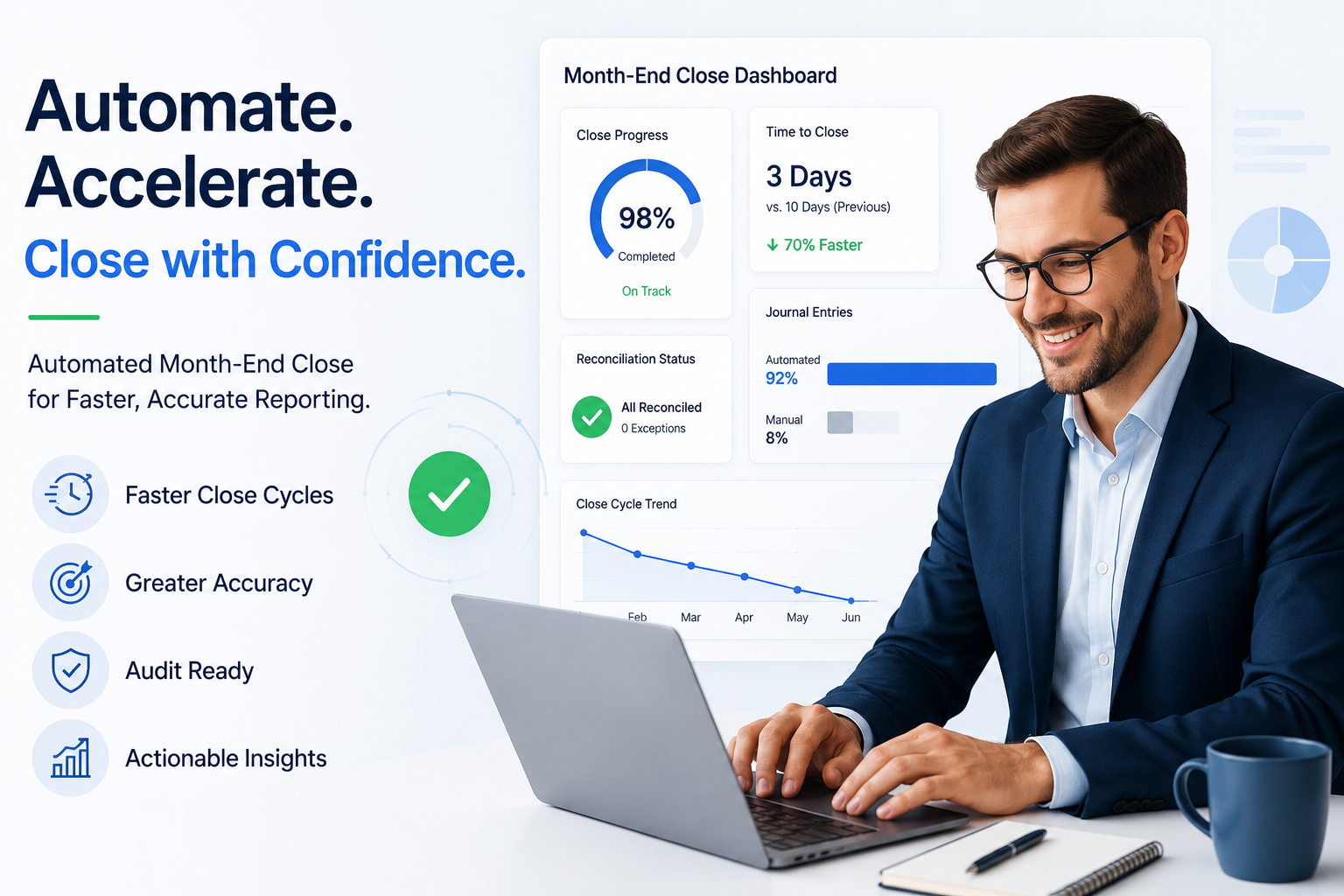

Automating month-end close reporting often presents a significant challenge for enterprise finance teams, plagued by manual data extraction, reconciliation complexities, and a relentless pressure for speed. The inherent inefficiency and potential for error in manual month-end processes lead to delays in critical financial reporting, impacting strategic decision-making and compliance. This article outlines how organisations can significantly reduce manual effort, accelerate close cycles, and improve reporting accuracy through advanced automation, exploring the practical playbook for implementing such systems and operational impacts.
The Persistent Challenges of Manual Financial Close
Enterprise finance operations routinely grapple with labor-intensive month-end close processes. These cycles often span weeks, involving disparate data sources, manual journal entries, and extensive spreadsheet consolidation. Such manual efforts are prone to human error, leading to inaccuracies that necessitate time-consuming recalculations and re-submissions.
The reliance on legacy systems and fragmented data further exacerbates these challenges. Financial controllers and accounting teams spend an inordinate amount of time on data aggregation rather than analysis, diminishing their capacity for strategic insights.
This situation directly impacts the timeliness and reliability of financial statements, creating a bottleneck for executives who depend on rapid, accurate information for informed strategic planning and operational adjustments.
Understanding the Imperative for Automated Close Processes
The transition from traditional, manual close procedures to an automated framework is no longer merely an efficiency play; it is a strategic imperative for competitive enterprise finance functions. Automated close reporting addresses core pain points by streamlining data flow, standardising reconciliation, and accelerating report generation. This shift enables finance departments to move from reactive data gatherers to proactive business partners.
Before the adoption of automation, reporting speed was sluggish, often taking 10-15 business days to finalise. Error reduction was a constant battle, with significant reconciliation efforts draining resources. Decision-making improvement was hampered by outdated or potentially inaccurate data. After implementing automated close solutions, reporting speed often improves by 30-50%, typically completing within 3-5 business days. Error rates can decrease by 20-40% due to automated checks and validations, leading to a 25% faster resolution of discrepancies. This drastic improvement in data quality and velocity empowers better, data-driven decision-making across the enterprise.
Key Architectural Components
A robust automated financial reporting architecture is founded on several interconnected components designed for efficiency and integrity. It begins with a sophisticated data ingestion layer, capable of pulling information from diverse enterprise resource planning (ERP) systems like SAP and Oracle, as well as CRM platforms, human capital management (HCM) systems, and other operational data sources. This layer prioritises secure, real-time data capture and validation at the source.
Following ingestion, a centralised data processing engine performs harmonisation, normalisation, and initial transformation. This ensures data consistency across disparate sources. A unified financial data model serves as the single source of truth, structuring all financial and operational data in a coherent, auditable manner. Finally, an advanced reporting engine, often incorporating artificial intelligence for anomaly detection and predictive analytics, generates dynamic financial dashboards and statutory reports with embedded audit trails and traceability features.
The Operational Impact of Financial Reporting Automation
Automated financial reporting extends far beyond simply accelerating the close; it fundamentally redefines operational workflows and enhances strategic capabilities. By removing the drudgery of manual data handling, finance professionals can dedicate more time to value-added activities such as variance analysis, forecasting, and strategic planning. This shift can lead to a 10-18% uplift in financial team productivity, directly impacting cost reduction and overall enterprise performance.
Accuracy is significantly enhanced through automated validation rules and reconciliation checks, dramatically reducing the risk of errors and subsequent restatements. The system provides comprehensive audit logs and granular access control, ensuring complete data lineage and superior audit readiness. This enhanced governance structure not only supports compliance but also instills greater confidence in the integrity of financial data, fostering a culture of transparency.
| Capability | Traditional | AI System |
| Data Aggregation | Manual, error-prone, fragmented spreadsheets. | Automated, real-time integration from diverse sources. |
| Data Lineage Tracking | Difficult, relies on documentation, opaque. | End-to-end audit trails, transparent data flow. |
| Multi-Entity Consolidation | Complex, manual adjustments, long cycles. | Automated, rule-based, rapid consolidation with intercompany eliminations. |
| Audit Readiness | Laborious data preparation, potential for delays. | Continuous readiness, built-in controls, instant access to documentation. |
| Scenario Modelling | Static, limited variables, slow iteration. | Dynamic, AI-driven, real-time what-if analysis. |
This comparative overview highlights the stark contrast between antiquated and modern financial reporting paradigms. AI-powered systems provide not just speed but also depth and foresight, moving finance from a historical record-keeping function to a forward-looking strategic partner. The ability to perform dynamic scenario modeling, for instance, transforms financial planning from a periodic exercise into an agile, continuous process, enabling quicker responses to market shifts.
Scenario 1: Accelerating Multi-Entity Consolidation
Problem: A global conglomerate with operations across 15 countries faced a month-end close cycle of 18 business days. Their consolidation process involved manual data uploads from various ERP instances, extensive intercompany reconciliation in spreadsheets, and manual currency translation adjustments, leading to frequent errors and significant delays.
Implementation: The organisation deployed an automated financial close solution designed to integrate directly with all regional ERP systems. Automated rules were configured for intercompany eliminations, currency translations, and minority interest calculations. A centralised dashboard provided real-time visibility into the consolidation status across all entities.
Measurable Outcome: The close cycle was reduced to 7 business days, a 61% improvement. Manual intercompany reconciliation efforts dropped by 85%, freeing finance personnel for high-value analysis. Reporting accuracy improved by eliminating manual data manipulation, enhancing confidence in consolidated financial statements for external stakeholders.
Scenario 2: Enhancing Audit Readiness and Compliance
Problem: A publicly traded manufacturing company struggled with extensive preparation time for annual audits. Compiling documentation for revenue recognition, expense accruals, and balance sheet reconciliations was a multi-week effort, often requiring numerous back-and-forth requests from auditors due to fragmented data and inconsistent supporting evidence.
Implementation: An automated reporting system with embedded audit trails and enhanced traceability was implemented. All transactions, adjustments, and reconciliation steps were automatically logged and linked to source documents. Role-based access controls ensured data security, and automated reports were configured to provide auditors with self-service access to validated data and supporting evidence.
Measurable Outcome: Audit preparation time was cut by 40%, with audit completion accelerated by three weeks. The finance team experienced a 30% reduction in auditor queries due to the transparency and integrity of the system-generated documentation. This led to lower audit fees and a stronger compliance posture.
High-Performance Dashboard Design for Enterprise Finance
Modern financial reporting dashboards move beyond static charts and figures, offering interactive, real-time insights tailored to diverse user roles. A high-performance dashboard layout prioritises clarity, navigability, and actionable intelligence. Key performance indicators (KPIs) such as working capital, operational cash flow, debt-to-equity ratio, and revenue growth are prominently displayed, allowing for quick comprehension of financial health.
Interactive drill-down capabilities enable users to explore underlying data, from summarised metrics down to individual transactions. Visualisations are carefully selected to convey complex information intuitively, supporting financial dashboards that cater to CFOs, business unit leaders, and operational managers. This fosters a shared understanding of financial performance and drives collaborative decision-making.
What Differentiates Modern Financial Reporting Platforms
Modern financial reporting platforms are fundamentally different from traditional Business Intelligence (BI) tools or basic ERP reporting modules. While BI tools offer data visualisation, they often lack the deep financial context, pre-built accounting intelligence, and automated reconciliation capabilities required for enterprise finance. ERP reporting is typically limited to data within that specific ERP, making cross-system consolidation and analysis cumbersome.
These advanced platforms are designed with finance workflow automation as their core. They incorporate an intelligent financial data model, real-time data integration across all enterprise systems, AI-driven reconciliation, anomaly detection, and robust governance features like audit logs and access controls. This comprehensive approach delivers a unified, trustworthy view of financial performance that generic BI or single-system ERP reports cannot provide. Organisations seeking to consolidate financial data from multiple subsidiaries, enhance regulatory compliance, or gain predictive insights into their financial future are the primary beneficiaries of such integrated solutions.
Key Deployment Challenges
Implementing an automated financial reporting system is not without its complexities. Key deployment challenges often include managing extensive data migration from legacy systems, which can be time-consuming and require meticulous validation. Integration with existing ERPs, CRMs, and other operational platforms demands robust APIs and careful mapping to ensure seamless data flow without disruption to ongoing business operations.
Organisational change management is equally critical. Finance teams must adapt to new workflows and acquire new skill sets, necessitating comprehensive training and clear communication strategies. Overcoming resistance to change and ensuring user adoption are paramount for the long-term success of the implementation. A phased rollout approach, starting with a pilot division or a specific reporting process, can mitigate risk and build confidence within the organisation.
How NumeriQu Enables This Capability
NumeriQu provides a unified platform that addresses the complexities of financial close and reporting through a structured, automated workflow. It begins with intelligent data ingestion, capable of connecting seamlessly with diverse enterprise systems, including major ERPs like SAP and Oracle, alongside CRM platforms and other operational data sources. This ensures that all relevant financial and operational data are automatically pulled into a centralised environment.
The system then processes this data through a proprietary financial data model, which harmonises information from disparate sources into a consistent, auditable structure. NumeriQu incorporates AI-driven reconciliation engines that automate variance detection, flag anomalies, and suggest corrections for intercompany transactions, account balances, and general ledger entries. This significantly reduces manual effort and improves accuracy. The platform generates dynamic financial dashboards and statutory reports in real-time, offering granular insights and full data lineage. Unlike generic BI tools, which provide data visualisation without inherent financial intelligence, or standard ERP reporting, which is limited to a single system’s data, NumeriQu integrates domain-specific accounting logic and cross-system consolidation capabilities. This allows enterprises to achieve a faster, more accurate, and more compliant financial close by unifying fragmented data and automating complex financial processes that span the entire organisation.
Technology Maturity and Enterprise Adoption Timeline
The maturity of automated financial reporting technologies has evolved significantly, moving from simple robotic process automation (RPA) for task-level automation to sophisticated AI-powered platforms offering end-to-end process orchestration. For enterprises considering adoption, a typical timeline involves several phases. The initial phase (3-6 months) focuses on discovery, vendor selection, and pilot implementation, targeting a critical pain point such as intercompany reconciliation. The second phase (6-12 months) expands to broader integration, encompassing core close processes like journal entry automation and sub-ledger reconciliations across multiple entities. The final phase (12-18+ months) involves leveraging advanced analytics, predictive forecasting, and scenario modelling capabilities, fully embedding the system into strategic financial planning. Successful adoption relies on executive sponsorship, a dedicated implementation team, and continuous training to foster a data-driven culture within the finance department.
Key Takeaways
- Automated month-end close reporting significantly reduces manual effort and accelerates the financial close cycle.
- Modern systems offer enhanced accuracy, improving decision-making through reliable, real-time financial dashboards.
- Key architectural components include intelligent data ingestion, a unified financial data model, and AI-powered reporting engines.
- Implementing such solutions offers substantial operational impact, including efficiency gains and superior audit readiness.
- Differentiated platforms integrate deep financial context and cross-system consolidation, unlike generic BI or single-ERP tools.
- Successful deployment requires careful data migration, robust system integration, and proactive change management strategies.
Frequently Asked Questions (FAQs)
What is automated month-end close reporting?
Automated month-end close reporting leverages technology to streamline and accelerate the process of preparing financial statements, reducing manual tasks, and improving data accuracy.
How does automation improve financial reporting accuracy?
Automation improves accuracy through built-in validation rules, automated reconciliation checks, and a centralised data model that minimises manual data entry errors and inconsistencies across sources.
Can automated systems integrate with existing ERPs?
Yes, advanced automated reporting systems are designed to integrate seamlessly with various existing ERP platforms (e.g., SAP, Oracle) and other operational systems to pull data efficiently.
What kind of efficiency gains can be expected?
Organisations can typically expect 30-50% reductions in close cycle times, 20-40% lower error rates, and 10-18% increased productivity for finance teams by automating financial close processes.
Who benefits most from implementing these systems?
Enterprises with complex financial structures, multiple subsidiaries, high transaction volumes, or those under intense regulatory scrutiny benefit most from these systems due to their ability to consolidate data, enhance compliance, and provide rapid insights.
If your organisation is evaluating scalable operating models, Automating Month-End Close Reporting with NumeriQu : A Practical Playbook may warrant a structured review across cost, governance, and long-term operational resilience.
To explore what that could look like in practice, contact NumeriQu for a consultative discussion.